

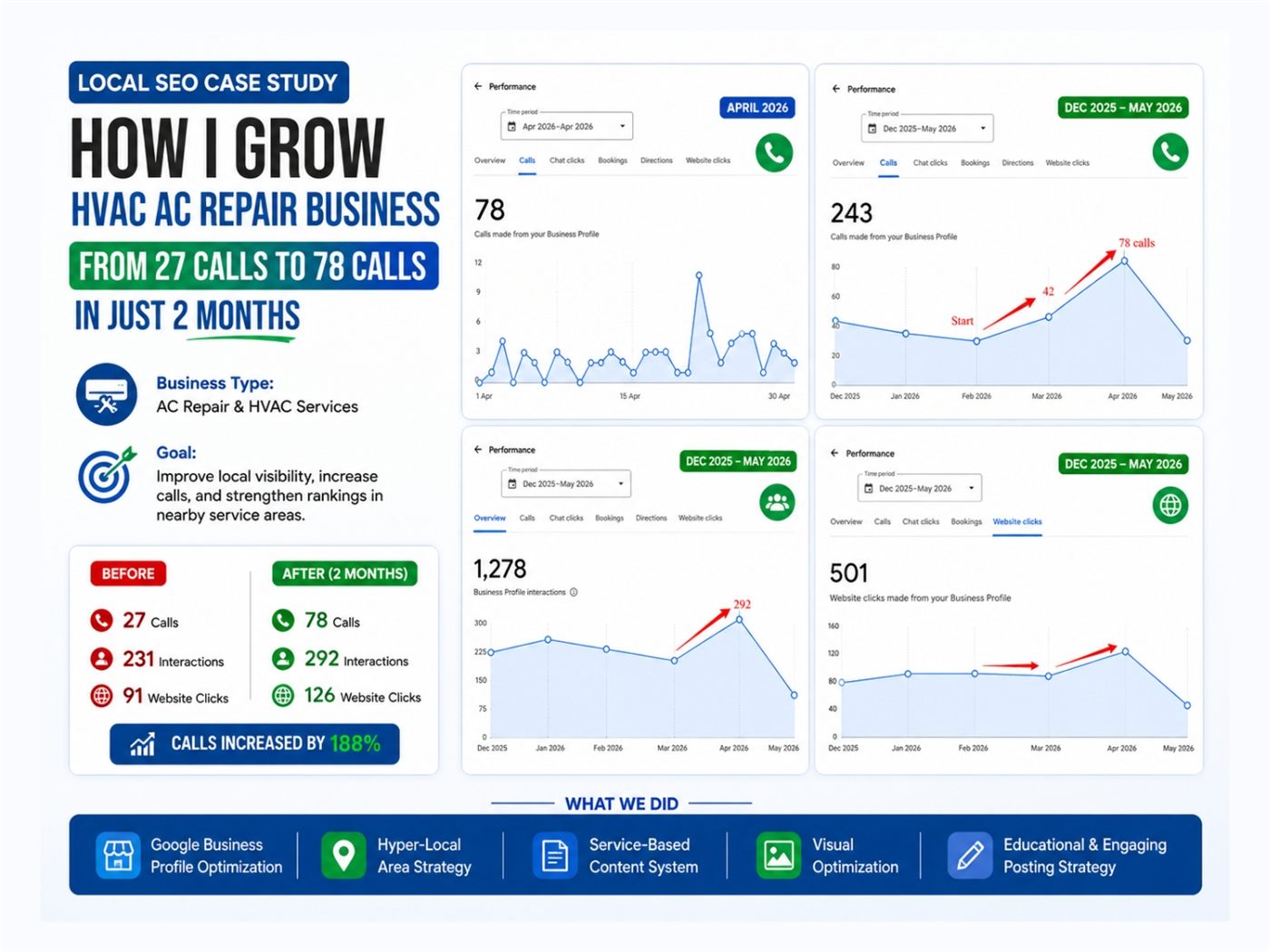
This wasn't a growth hack. No fake reviews, no spam backlinks, no keyword stuffing. Just a properly structured Local SEO system focused on three things: visibility, trust and local intent.
The starting position was ordinary, which is what makes it useful. The Google Business Profile already existed. It had been set up, presumably competently, and then left alone.
- 27 monthly calls
- 231 business profile interactions
- 91 website clicks
Two months later:
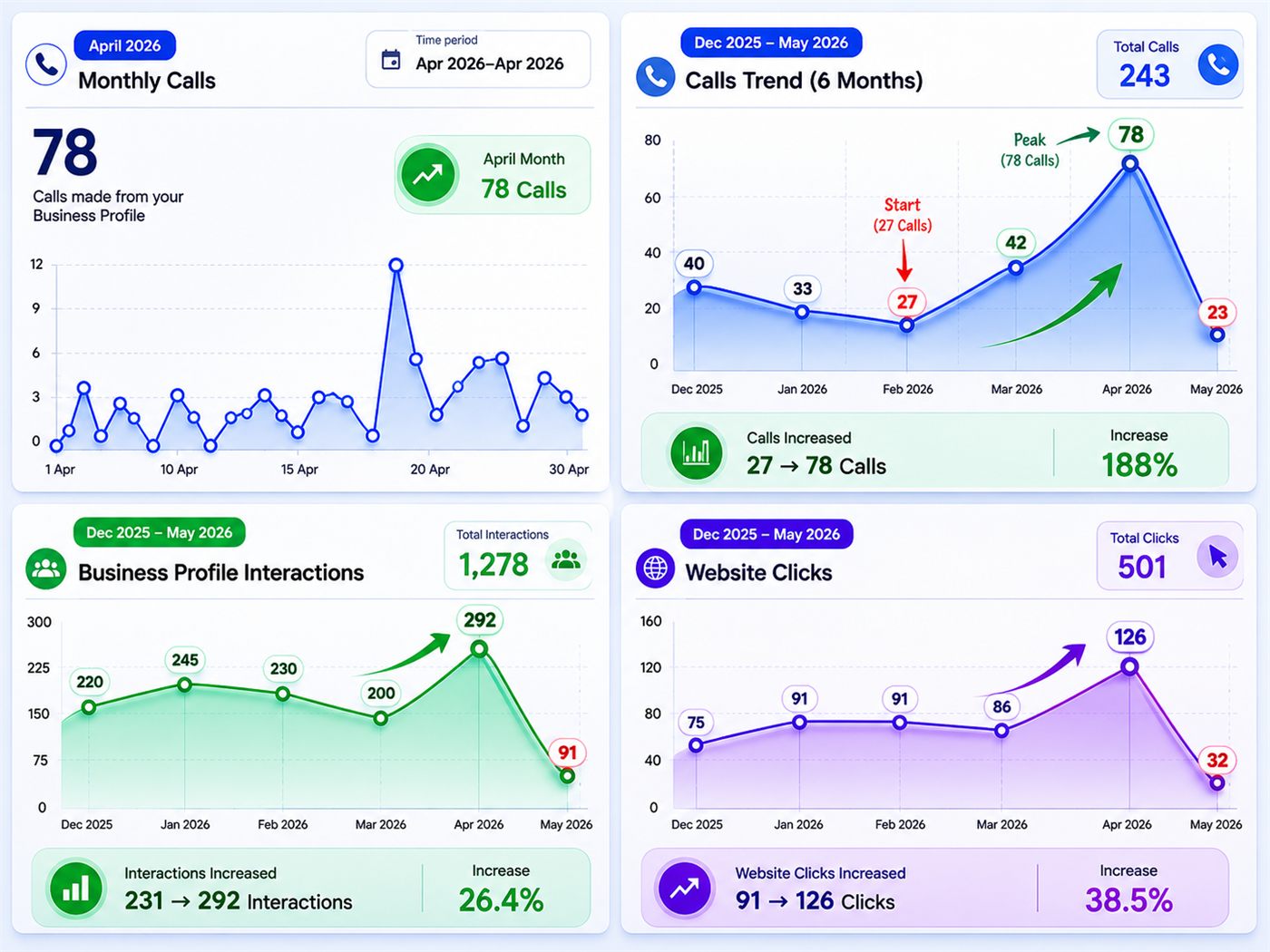
- 78 monthly calls, up 188%
- 292 interactions, up 26.4%
- 126 website clicks, up 38.5%
The mistake almost every local business makes
They optimise a Google Business Profile once and expect Google to keep ranking them forever. That's how local search worked several years ago. It isn't how it works now.
Google rewards activity, relevance, consistency and local trust signals, not setup. A profile that was excellent eighteen months ago and untouched since is, from Google's perspective, a profile it has no current reason to trust.
The five changes, ranked by impact
1. Hyper-local area strategy, the biggest lever
The business was targeting its main city. That's the instinct, and it's too narrow. We expanded relevance into nearby service areas, Dubai Marina, Al Barsha, Business Bay, Jumeirah and surrounding residential communities.
This is what changed the geography of the results. The business started appearing consistently across nearby areas instead of only its core location. And that mattered more than the raw call count, because it changed the quality of leads: people searching in areas the business could genuinely serve profitably.
2. Google Business Profile restructuring
A complete rework of services, products, categories, business description and posting structure. Every section optimised around service intent, nearby-area targeting, natural language and customer-focused wording, not robotic keyword stuffing.
The distinction matters. Writing "AC Repair Dubai Marina AC Repair Business Bay" into a description doesn't build relevance; it signals a profile trying to game a system that stopped rewarding that years ago.
3. Service-based content structure
Most HVAC businesses list one thing: "AC Repair". We built structured coverage across AC repair, AC maintenance, AC cleaning, emergency AC repair and AC installation, each supported with customer problem intent, local search relevance and natural keyword placement.
This significantly improved topical depth, which is what lets Google understand you as a genuine specialist rather than a listing with a category attached.
4. Visual optimisation, the most underrated
Almost every business ignores this, and I think it's the single most under-exploited part of local SEO right now. We focused on geo-relevant images, real service photos, area-focused visuals and optimised image file naming.
Google increasingly uses visual signals to validate that a local business is genuinely active and authentic. Stock photos of generic air conditioners tell it nothing. Photos of your technician working in an identifiable neighbourhood tell it a great deal.
5. Educational posting strategy
Competitors were posting generic promotions, discount graphics and "Best AC Repair" spam. We posted educational content, maintenance awareness, seasonal AC issues, area-focused updates and problem-solving posts.
This improved engagement and local relevance steadily rather than dramatically, it's a compounding input, not a switch.
What modern local SEO actually rewards
Most local businesses still treat a Google Business Profile like a directory listing. It stopped being one. What it now responds to:
- Entity trust, does Google know what this business is, confidently?
- Service authority, is there real depth behind each service claim?
- Local relevance, is the business demonstrably connected to the areas it targets?
- Consistent activity, is this profile alive?
- Visual authenticity, does the imagery corroborate the claims?
You don't need hundreds of backlinks to grow a local service business. You do need clear local signals, proper service structure, nearby-area relevance and consistent activity.
One caveat on the numbers
Look at the six-month trend and you'll see May came in at 23 calls after April's peak of 78. Seasonality is real in HVAC, and I'd rather show you the whole curve than crop it at the flattering point. The structural gains, the nearby-area visibility, the service depth, hold regardless. The monthly peak moves with demand.
Any local SEO case study that shows you a line going permanently up is showing you a selected window.