

There is a default reflex in SEO that goes something like this: traffic is flat, so we need more articles. Publish more, rank more, grow more.
It's an expensive reflex, and often the wrong one. On one of the larger technical SEO projects I've worked on, the site had the opposite problem. It published consistently. It had indexed pages. It had existing search visibility. And it was still underperforming badly relative to the size of its content library.
The problem wasn't a lack of content. It was how that content was structured and discovered.
What the audit actually found
When I went through the site properly, four things stood out, and none of them were solved by writing anything new.
- Important pages weren't receiving enough internal authority. The pages the business most wanted to rank were buried, linked to rarely, and treated by the site's own architecture as unimportant. Search engines took the hint.
- Content topics lacked a clear hierarchy. There was no visible structure signalling which topics the site was genuinely authoritative on and which were peripheral.
- Several pages overlapped in search intent. Classic cannibalisation, two or three pages competing for the same query, forcing search engines to pick, and none of them winning decisively.
- Internal linking opportunities were being missed everywhere. Related pages sat in isolation with no connective tissue between them.
Every one of those is a structural problem. You cannot fix any of them by adding another blog post, in fact, adding more content to a site with these issues usually makes them worse, because you're pouring more pages into a system that already can't prioritise.
What I changed
The work split cleanly into two halves.
Technical improvements
- Crawlability review, making sure search engines could actually reach what mattered
- Indexation analysis, finding what was indexed that shouldn't be, and what wasn't that should
- Internal linking optimisation, deliberately routing authority toward priority pages
- Site structure improvements
- Ongoing Search Console monitoring and technical issue resolution
Content structure
Technical fixes alone weren't enough. The way topics related to each other needed rethinking too:
- Content organisation and topic relationship mapping
- Search intent alignment, matching each page to one clear job
- Content consolidation, merging pages that were splitting their own authority
- Reducing keyword cannibalisation
The objective was simple to state and slow to execute: create a clearer relationship between topics so search engines could understand what this site was genuinely expert in.
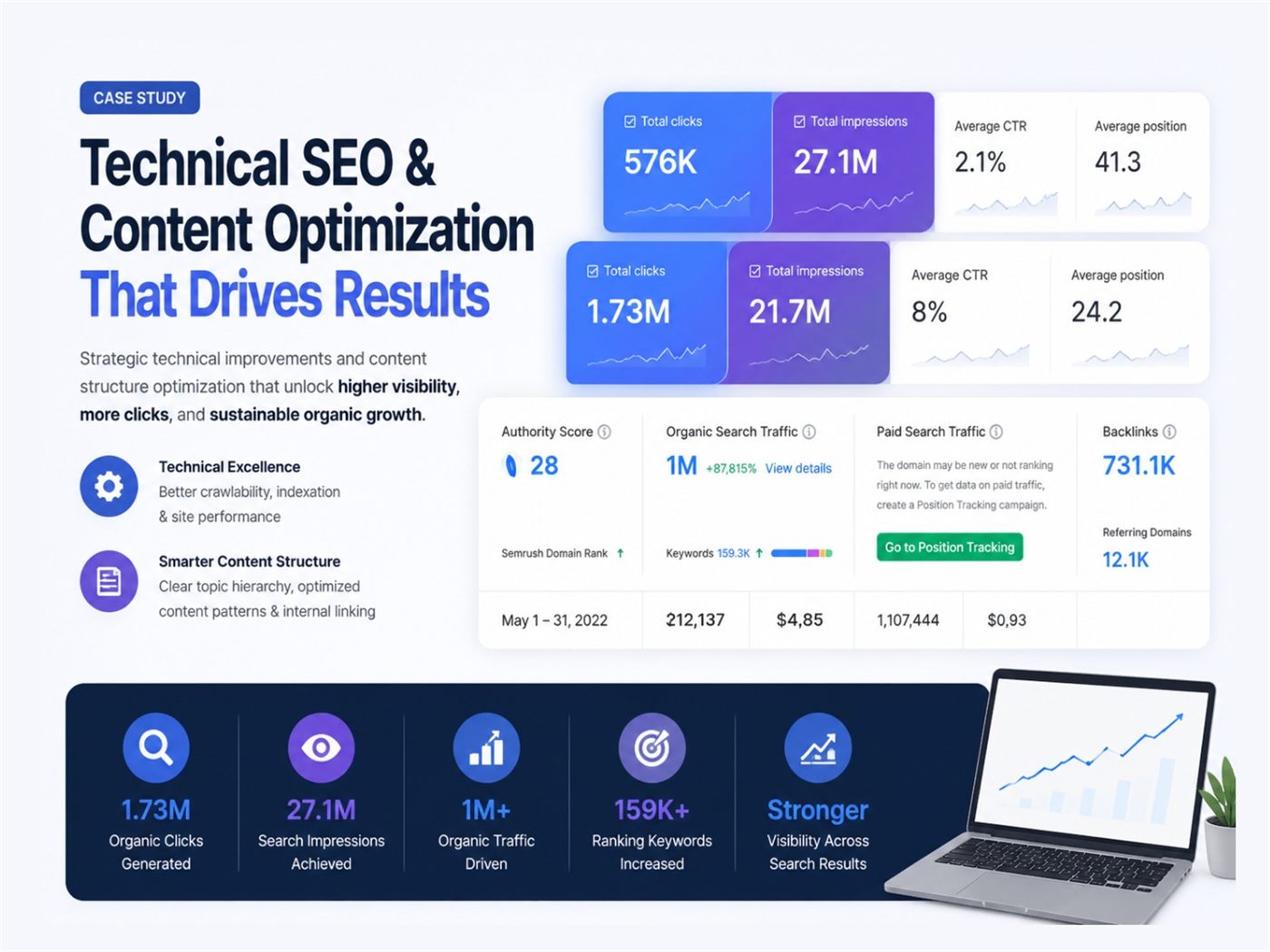
The result
- 1.73M organic clicks
- 27.1M search impressions
- 1M+ organic search traffic
- 159K+ ranking keywords
What matters more than the figures is where they came from. This growth was achieved by improving existing assets, not by scaling up production. The content was already paid for. It just wasn't working.
Many websites assume they need more content to grow. In reality, growth often comes from helping search engines better understand the content that already exists.
How to tell which problem you have
Before you commission another twenty articles, three checks worth running:
- Impressions versus clicks in Search Console. High impressions and low clicks means you're being seen and not chosen, a relevance and presentation problem, not a volume problem.
- Query overlap. Sort your pages by query. If several rank for the same term and all rank mediocrely, you have cannibalisation, and publishing more will deepen it.
- Click depth to your money pages. Count how many clicks it takes to reach your most commercially important page from the homepage. If it's more than three, your own site is telling search engines that page doesn't matter.
If those three checks come back clean and you still have thin coverage of your core topics, then yes, write more. But run the checks first. The cheapest growth available to most sites is already sitting on their servers.
Why this matters more for small businesses
Large sites can afford to brute-force the problem. A small business usually cannot. If you've got forty pages and a limited budget, the difference between those forty pages being structured well or structured badly is the difference between competing and being invisible.
Structure is also durable in a way content volume isn't. A well-organised site with clear topical hierarchy keeps compounding. A pile of disconnected articles decays.